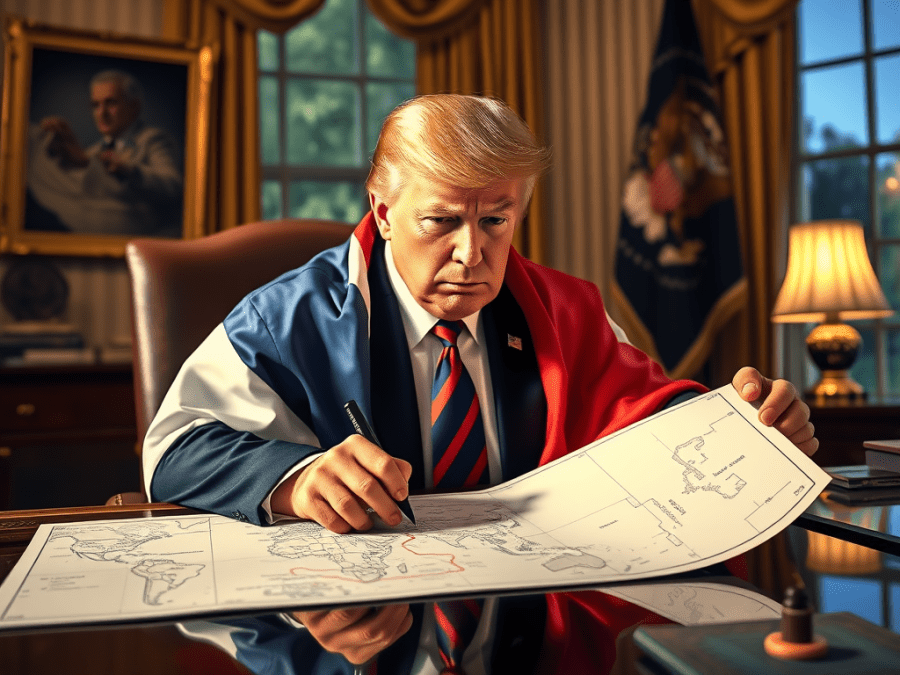
Mainstream media has tirelessly portrayed President Trump’s so-called trade war as little more than reckless — even downright hostile. But what if there is more to it than we generally appreciate? The President has stressed that fair and reciprocal trade sends a message that tariffs, as a rule, are unfair. He has been nothing if not consistent — in interviews as far back as the 1980s — that trade must not be a “one-way street“. Importing far more than Americans are capable of exporting to other countries adds up to revenue losses, lower wages and fewer jobs for Americans.
Change is hard. And the risks are not trivial: Persistent inflation is one of those risks. Geopolitical tension is another. The European Union and Canada, for example, have threatened to retaliate against steel and aluminum tariffs. China has said it is ready for trade war and a conventional war “till the end“. Michigan electric grid operators have expressed fear that tit-for-a-tat tariffs will impact power delivery. And yet setting aside the pitfalls of rocking the boat, the truth remains: As the world’s top trade partner, the United States of America has little choice but to embrace economic diversification and the re-shoring of manufacturing. Why now? Because, unlike the 1990s and early- to mid 2000s, the rise of artificial intelligence will not leave white collar jobs unscathed. The days of presidents Clinton, Obama and Biden blithely urging working class America to “learn to code” are in the rearview mirror.
While debate exists on how best to rebalance trade, few disagree that it is necessary.
Until relatively recently, one area the U.S. enjoyed a trade surplus on was agriculture. But that, too, has changed with the years-long siege on farmers — a situation made critical by the Biden-era war on fossil fuels, which drove up farm input costs and shut down many producers even as the would-be profiteers of a “farm apocalypse” cheered on disaster as a form of climate progress. Today, the U.S. is no longer food secure — meaning we import more food than we export. Ask yourself: What kind of superpower relies on other countries to feed it? Similarly, how will this or any future administration address the cost of living crisis, if grocery prices remain stubbornly high because food that travels a greater distance from farm to plate generally costs more?
The 2008 film I.O.U.S.A., spearheaded by former Comptroller General David Walker, warned that if the U.S. fails to get our fiscal house in order we will not only run out of money to fund Social Security, Medicare and the like — but even national defense. With the U.S. trade deficit nearing $1 trillion in 2024 and virtually any and all trade surpluses having gone up in smoke beginning in the mid 1970s, for the first time in history interest on the national debt is so great it now exceeds the single-biggest expenditure the federal government has: defense spending.
Precarious does not even begin to describe our predicament. The U.S. has only one steel producer left, which Japan has attempted to acquire, and only four aluminum smelters. Metallurgical capacity isn’t just critical to the auto industry but to the fabrication of tanks, aircraft and munitions critical to national defense. What’s more, even our ability to produce life-saving pharmaceuticals is negligible — with dependence on China accelerating since PPE shortages were called out at the height of the COVID-19 pandemic. Ground the Rust Belt ceded during the “free trade free-for-all” of the 1980s onward has now come home to roost for all Americans in the form of $37 trillion in federal government debt, leaving little choice but to downsize the federal government.
The U.S. cannot deindustrialize and expect to remain a global super power.
The problem with “free trade” is that it cannot exist in any pure sense of the word unless all market participants are magnanimous and without selfish interest — which is never the case in real world application. As such, lopsided free trade agreements (FTAs), over a ~40 year period have reduced the U.S. to a service economy. Increasingly, though, Americans are broke — leaving the ~70 percent of the economy tied to consumer spending to rest on the shoulders of just 10 percent of top income earners. Beyond a historic wealth gap, this amplifies the uniparty incentive to cater to the whims of a small subset of the population — hardly a win for democracy!
Access to cheap goods is not the essence of the American Dream. The American Dream is rooted in the concept that any citizen can achieve prosperity, upward mobility, and economic security. For too long, the designers of multilateral trade deals have lost sight of this. International economic relations that do not work for the American people must be re-examined.
Treasury Secretary Scott Bessent
This is what tariffs are designed to address – leveling the playing field such that the international trading system begins to reward ingenuity, security, rule of law, and stability, not wage suppression, currency manipulation, intellectual property theft, non-tariff barriers and draconian regulations. To the extent that another country’s practices harm our own economy and people the United States will respond. This is the America First Trade Policy.
The World Trade Organization protests in Seattle in 1999 revealed that a wide swath of Americans understood, not unlike their Canadian and European counterparts, that the offshoring of jobs did not merely threaten mom-and-pop shops and local identity but represented a step backwards for labor conditions, favoring insufficient safety, human rights and environmental protections. Indeed, the pursuit of rock-bottom labor costs placed entire economies in the crosshairs — even as free trade proponents across the political spectrum sung the praises of “lifting all boats“.
In hindsight, one can argue that the only thing that forestalled an even more profound hollowing out of the American economy was the personal computing revolution, after which Microsoft, Apple and others created a large number of jobs in Silicone Valley, Seattle and elsewhere. But that was then and this is now: Expecting to ride the next Big Tech wave is hardly a given as AI remakes the 21st Century global economy — hence the answer to “Why here?”, “Why now?” and “Why Trump?”
While there can be no doubt that the President’s America First trade policy is high stakes, taking our trade partners down with us as our economy collapses under the weight of gargantuan debt is not a viable solution, either. It bears acknowledging that Democrats, with notable exceptions, were among the first to admit that “bipartisan” free trade deals harmed the working class. Today, the so-called party of the rich (Republicans/rhinos) is dwarfed by middle America (populists/MAGA) even as the party of the blue collar (Democrats/progressives) are preoccupied with woke cultural battles and the defense of the institutional/elite status quo. Wall Street, for its part, remains fixated on corporate earnings reports — profits padded by decades worth of offshoring — only to emerge, unironically, in the press to warn of the dangers of not paying our bills.
Between the daily grind of petty partisan politics and the Nasdaq closing bell lies a vacuum waiting to be filled by leadership — a trait so rare it seems antithetical to how a modern American president is “supposed to behave” in office.
At the end of the day, someone had to be the “bad guy” and come into high elected office with the conviction to tackle the self-licking lollipop that is Big Government and Big Business with its attendant financialization of everything. Rather than wish failure on Trump — which would amount to taking a wrecking ball to the global economy — better that Americans and our trade partners exercise forbearance. After all, as the U.S. economy goes so does the global economy.
That so many career politicians are too feckless to call for accountability from America’s trade partners should not delude us into concluding that neglect is normalcy and change is malice. As Americans learned in Butler, PA last summer, “Fight! Fight! Fight!” is more than a Trump campaign slogan. Courage is controversial — but also contagious. Awareness raised by the WTO protest of 1999 may have long since faded from public consciousness but for a 78-year-old Donald J. Trump, righting the wrongs of “Globalization 1.0” is very much a case of now or never.
###
 The Social Critic