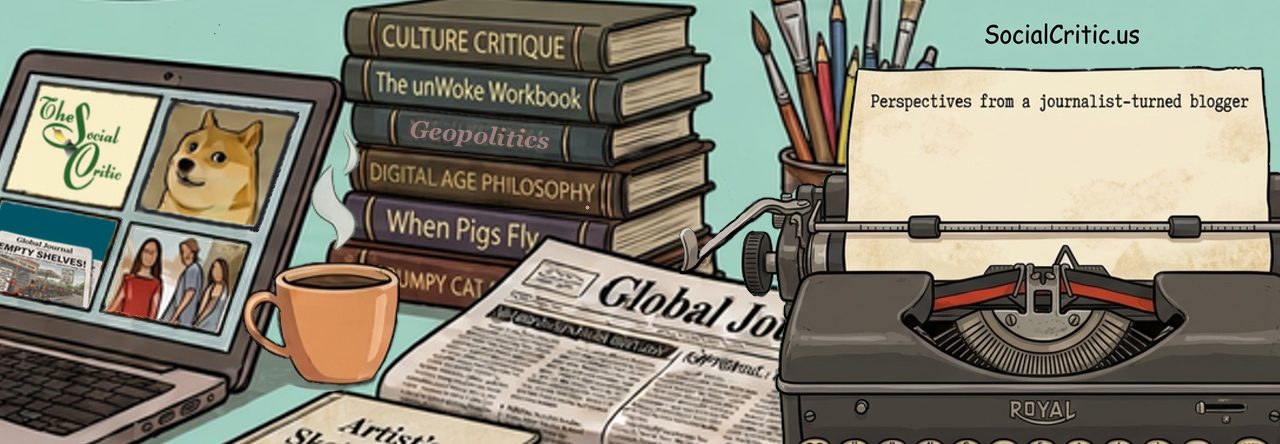
The Social Critic has its roots in an earlier endeavor, launched while I attended college in Southern California to obtain a journalism degree. Back then, we called blogs “ezines”. Mine existed to document the transformative influences of the time, from Big Tech to changing cultural norms, through the lens of current events. It gathered enough following to eventually land in the Wayback Machine.
Those early days of the internet were a Wild West — with Jeff Bezos selling books out of his garage, Netscape Navigator, the browser of choice to explore the world wide web, chats over Instant Messenger — the smartphone came later! — and the incessant forwarding of chain emails from a friend-of-a-friend-of-a-friend, that promised to reveal who Bill and Hillary Clinton would suicide next.
The fantastic thing about that period is that anyone could become anything and anybody if they put their minds to it. Master a few key tools such as Adobe PageMill to “WYSIWYG” a functioning website, and one was off to the races. (Well, not quite. The internet was on “dial up” and “high speed” was a 56 Kbps modem!)
Gradually, however, things changed. The code became more complex. The vulnerabilities exposed. And early-to-the-finish-line blog hosting companies began to hold back core features necessary to maintaining a searchable presence on the likes of Google from all but their highest paying users.
The workaround? Social media: MySpace. Facebook. Twitter. TikTok. The rise of the influencer has long since surpassed expectations, leading to new ways to message, work and shape the culture wars.
Today, artificial intelligence has delivered the biggest Big Tech Wild West yet. Content creators are armed, like never before, with tools that can make anyone into their own storyboard editor, YouTube producer and animator.
Hosting companies that once held users hostage to “tiers” that left them unable to bring in new site traffic?
Forced to compete.
Adults over a certain age without a 14-year-old in the house to explain how it works?
There’s AI for that!
AI has created opportunities for bloggers to find new relevance as they optimize content for web search (Search Engine Optimization) and design better content — all without the need to hire a slew of experts to keep a modern web presence afloat.
True, change can be intimidating, if not genuinely disruptive. The creative professions, notably, are no longer the exclusive domain of classically trained professionals in art, film and music. Yet we are also living in exciting times, in which ordinary people find themselves equipped to bridge knowledge, if not also wealth gaps, that left many stuck in the past. Thanks to AI tools, the writer can become an artist. The artist can become a writer. And a podcaster can teach a master class.
What will this AI frontier bring? The capacity to destroy. The capacity to create. Both unequaled.
It’s what we make of it.
As longtime readers may note, this blog has undergone a visual refresh and is ready to embrace the next wave of cultural commentary and social criticism.
Readers will continue to find original, long-form essay content alongside newer, edgier satire created with the aid of AI.
Sometimes content will trend right. Sometimes it will steer left. And much of the time it will search for “unicorns” in the middle.
One thing it won’t be? Dull.
Enjoy the ride!
©2026
###
©2007/Archived Introduction
There are those who believe that blogging is largely narcissistic. Cathartic, yes, but narcissistic just the same. And who, above all, are supposed to refrain from this self-interested pastime? Journalists.
So I guess that makes me a hypocrite.
My resolve to remain “above” the blogging frenzy in order to maintain my credibility as a journalist has crumbled at the feet of an all-too-classic temptation: everybody’s doing it. Journalists are blogging and bloggers have become journalists.
So after an eight-year hiatus from the bimonthly social commentary e-zine I wrote and edited for three years — yes, that’s what they used to call them before someone coined the term “blog” — I’m back.
So what sets this present blog apart from the rest of the blogosphere?
Nothing, really.
Oh, I suppose I could mention the communications degree with emphasis in journalism. Or the fact that I have been published in newspapers and magazines.
But let’s be perfectly honest: Unless somebody gives me an “in” at the New York Times, TIME Magazine or the like, you won’t find my name on newsstands anytime soon.
That’s right, folks. As media celebrities go, you’re dealing with small potatoes. Still, if you give this up-and-comer a chance, I believe you will find a compelling voice and an even bigger heart — one that I will strive to elevate above the blogosphere norm.
Some bloggers use their bandwidth to to share anecdotes about their lives — the kind that one formerly addressed to “Dear Diary” and hid beneath the mattress.
That’s not why I’m here.
I’d like to believe I have a knack for finding nuggets of wisdom in life, faith, politics and media. So if I do this blog due diligence over the coming months and years, I hope you will come to agree.
Perhaps blogging doesn’t have to be inherently narcissistic after all.
I’ll let you be the judge of that.
###
Very interesting. Nice to have some honesty out there
Nice to hear from you! Please visit again soon!
Hello,
I am grategul your article about CCD (Colony Collapse Disoder) among North America’s essential Bee Polinator Population. Excellent Blog post, stay in touch with the Subjet to see if CCD is: Climate Chage Related, the result of Gentecically Engineered Food crops (now made harmful to Bees), or a chemical applicant that the Food Crop Growers are using, or worse yet some or all of the aforementioned factors combined.
I first learned of this CCD phenomenon about 5 years ago on Coast-to-Coast AM when Art Bell covered the ALARMING CCD and deaths of Bee Pollinators. I have noticed the Produce section of my local Supermarket has lately been Importing produce from further away (and more expensive Produce from South America and other other more expensive non-US crop sources.)
Unfortunately only with the backing of expensive Lawyers can one expect a quick resolution to where Washington, D.C. Congressmen and Senators become involved. They will take only take serious notice when the monetary losses from poor-to-non existant Crop yields seriously affects their jurisdiction. By the time the Washington D.C. legislators lauch a full-scale investigation into the cause(s) of CCD, two or more years from now (in my estimation), the CCD problem will likely be far more difficult to recover from.
Thank You for covering this important Topic in detail, and for providing the very informative Video on CCD bee pollinator losses.
We need funding for the Private University studies NOW, not later, later could be too late to fix and restore a sustainable bee hive level.
Just “trucking around” the Bees long distances of 400 miles or more causes enough stress to the Bee Pollinators that on averge 30% die just by moving the Bees around the U.S. to different farms. In the past bees were not “trucked around” great distances fom Farm to Farm, it was the responsibility of the farmer to maintain his or own Beehive Population on their farm for the purposes of Crop Pollination.
It is because of GREED that the bees are being uprooted from their home that THEY selected and forced into this manual work. This stress caused to the Bees by moving away from farmiliar areas they can navigate to a completely new area, often many miles away, is perhaps the cause or a major contributing cause to the alarming rapid Decline of the North America’s Bee Pollinator populations.
Add into that stress put upon the Bees, and possble lethalities shuch as fertilizer, crop dusting and the Genetic Modification of the Food Chain – may be what is causing this alarming spread of Bee CCD.
Unfortunately people vote with their wallets usually, so by the time serious Government funding becomes available to solve the Bee CCD dilemma in North America it may be too late to reverse.
Keep up the good work,
Gary Burke
Radio Free Colorado
http://www.radiofreecolorado.net
P.S. – We put a direct link to this topic on our heavily visitied website for you, because I myself want you to have as much exposure as possible to this Bee CCD dilemma.
Social critic–I read your follow up commentary on James Kunstler’s new book, very, very astute! I agree with almost everything. I too am a communications professional (or was), once worked for LA Times, grew up in Pasadena, now write books on “alernatives” from Cambria 200 miles north. I wish you well. See my work at williamseavey.com
My Accuwaether forecaster has stopped receiving a signal. Did they shut down ALA MSN?
Not to my knowledge. I have an Accuweather forecaster and so does one of my family members. They’re still working. If you’ve already ruled out low batteries, my guess is there is some form of interference that is preventing the internal antenna from pickup up the updates. Try relocating it. I love the desktop convenience of these forecasters even though I have a smartphone, so I certainly hope they don’t stop broadcasting the Accuweather signal!